The foundation under every project: understand your process
Every manufacturer has processes that officially live in the ERP and actually live in Excel, email and people's heads. Before you choose a system or commission software, you want to know how the work really flows today. That is the first step, always: short, concrete, and with a clickable result instead of a report.
- Duration
- Half-day sessions, not a months-long workshop series
- Result
- A clickable map of processes, systems and bottlenecks
- Price
- On request · proposal on a single page
Sound familiar?
Four situations we find at almost every manufacturer.
- The quote costing lives in a spreadsheet only one person dares to touch.
- Nobody knows which version of the planning is the real one.
- The ERP says four weeks lead time; the shop floor knows better.
- Every department keeps its own list next to the system.
Not every problem calls for a new ERP. Not every spreadsheet deserves an application. First the process, then the right solution.
What you get
In a handful of working sessions with the people who do the work, we map which processes exist, which systems and spreadsheets carry them, and where time, margin and versions leak away. No months-long workshop series: half-day sessions, captured on the spot.
The result is not a report but a living, clickable picture of your landscape: processes, systems, bottlenecks and how they connect. That is what you prioritise on: what comes first, what can wait, and what is not needed at all.
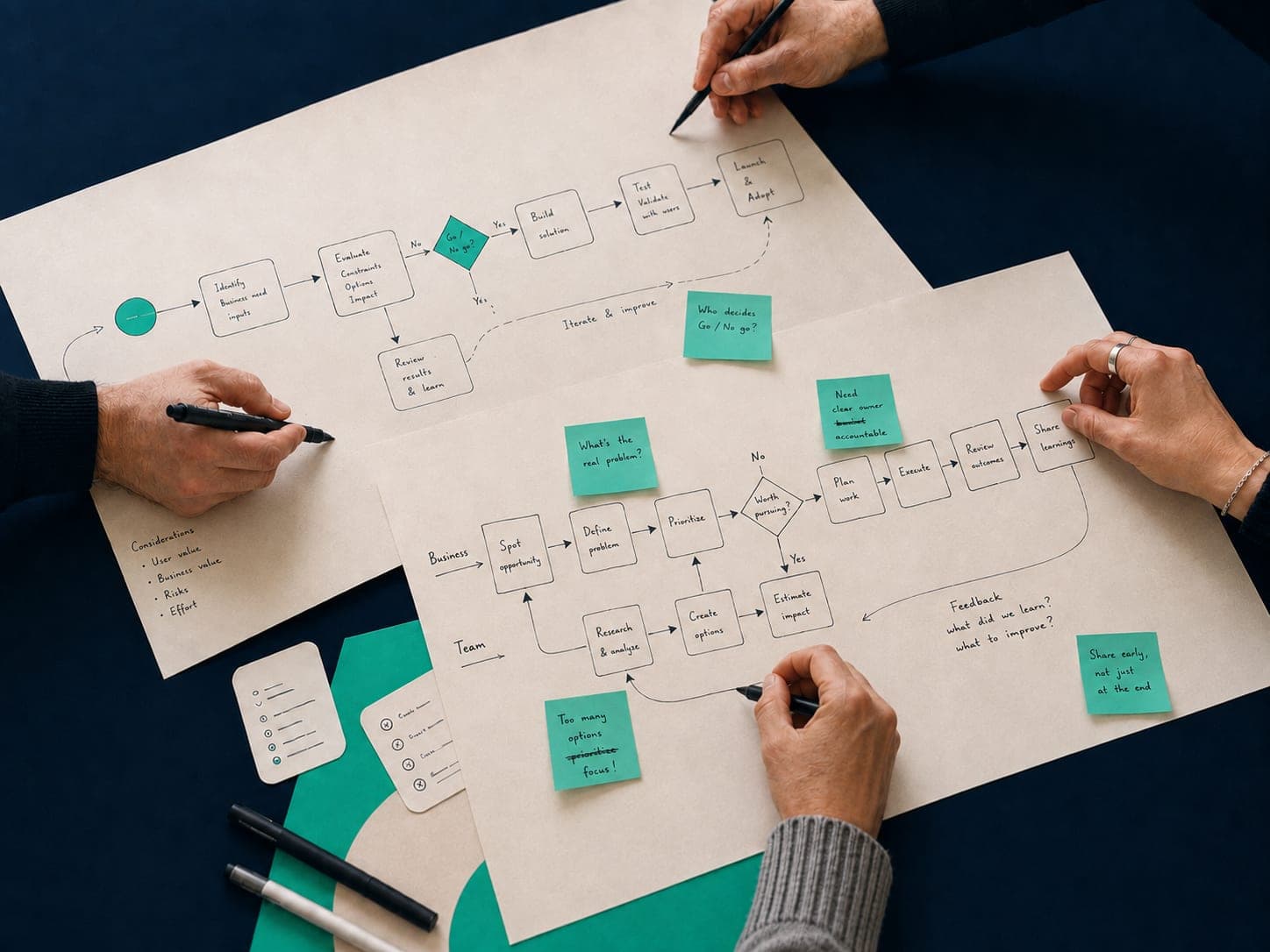
This is what your process looks like in Scope Compass
During the conversation we capture processes, systems and bottlenecks straight away. You click through it yourself, and you keep the picture: updatable the moment something changes.
Which systems and spreadsheets carry a process — including the files beside the ERP.
Bottlenecks and priority: what comes first, what can wait.
Scope Compass does more than map processes: requirements, scope and decisions come together in it. More about Scope Compass
The same result.
In three days.
3 to 6 months
- Hundreds of PowerPoint pages as the deliverable
- Dozens of Excel files with requirements
- Out of date the moment the project starts — nobody maintains it
3 days
- 90% of the required processes mapped
- Delivered in one manageable, extendable tool
- Reusable for the whole ERP project and for certifications
At an agritech manufacturer we did exactly this: two days of interviews with the key users, one day to sharpen the outcome. After that more than 90% of the processes were recorded — ready to improve, to build into the ERP, and to be maintained by their own people.
Why this belongs before any system decision
An ERP project that starts without a sharp picture of reality ends with a scope nobody recognises, and change requests nobody budgeted. The same goes for custom software: build for a process you do not understand and you get exactly that, software nobody understands.
That is why this is the first step: the map that makes the other two faster and safer.
And then? That depends on the outcome.
Two directions are possible, and often both are true for different processes. Both routes start from the same map, so you never begin at zero again.
The system is the problem
Then you choose and implement the right ERP — independently and in control. The map is your requirements base straight away, so selection and scope take weeks instead of months.
- 01Requirements straight from your processes
- 02Compare vendors on what you actually do
- 03Implementation without change-request arguments
The process fits no standard system
Then we build a focused app for it. Not expensive and not laborious: the process is already in the tool, so we build on what is there instead of asking again.
- 01No new intake — the process is already recorded
- 02Working prototype in 48 hours
- 03One process at a time, at a fixed price
Whichever route it becomes: the map stays the foundation. More about Scope Compass
Frequently asked questions
We think we know our process well. Does this still add anything?
Almost always. What people know is their own part; the gain is in the handovers between them, the exceptions, and the places where the system and practice drift apart. That is exactly what surfaces in a few sessions, and it is where time and margin leak away.
How long does such a project take?
A handful of half-day working sessions spread over a few weeks. We capture the outcome during the session, so there is no reporting phase afterwards.
What exactly is Scope Compass?
Our own instrument: processes, steps, systems, bottlenecks and assumptions in one environment. You click through your own landscape and keep the picture current as things change.
Do we have to buy something from you afterwards?
No. The map is yours, also if you continue with another party or do nothing for now.
We are already in an ERP project. Is this still useful?
Yes, and often especially then. A sharp process description holds the scope in place and shortens arguments about change requests.

See how the work really runs.
In a process session we capture, together with your people, what happens, who does it and where it pinches. After that you know whether the answer is an ERP, an app or neither.